 Africa Rural Atlas
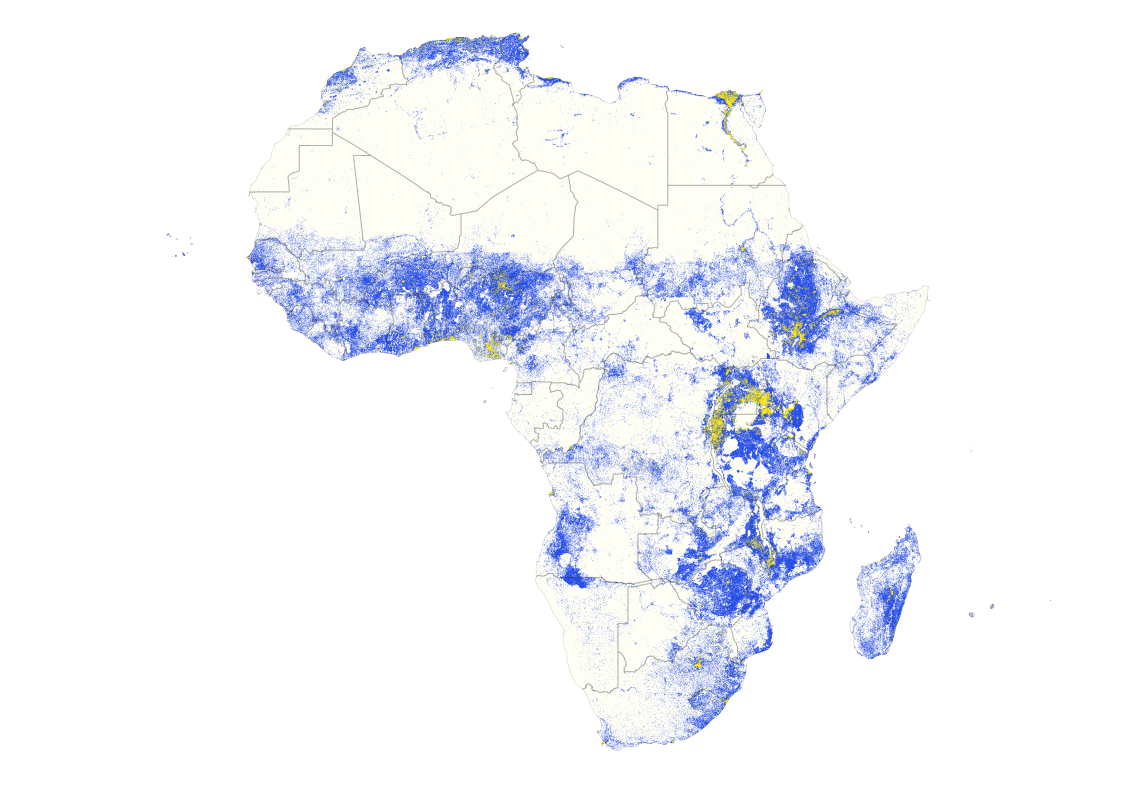
Part 1 – Population Distribution
Rural-Urban Divide
We begin by examining how rural and urban areas are distributed across Africa. This binary map uses a simple color scheme: yellow represents urban areas, blue represents rural areas, and white shows uninhabited regions.
Notice how yellow urban areas are always surrounded by blue rural zones—rural and urban never exist in isolation, but together as interconnected systems.
View full map →Population Density Patterns
Each circle represents an area of 10,000 km². The outer ring size indicates the proportion of rural area, while color intensity reflects population density.
Coastal areas (especially Nigeria and Ghana) appear much darker, showing high population density. Areas near the Sahara Desert are lighter, indicating sparse population. Rural populations dominate inland regions, while urban concentrations cluster along coasts and major cities.
Explore interactive map →Country & Regional Analysis
The dashboard breaks down population distribution by country and region, using pie charts to show the urban-rural split. Color intensity on maps corresponds to total population size.
Key insights: West and East Africa have both large populations and high rural ratios. North Africa has very few rural populations. The box plots reveal not just average urbanization levels, but also variance between countries within each region.
Open dashboard →Part 2 – Population and Road Distribution
Infrastructure Overview
This overview map depicts population density, road networks, and capital cities. The color scheme represents population density from yellow (urban densities) through shades of blue (varying densities) to black (uninhabited). Yellow lines show roads, white circles indicate capitals.
View full map →Distance to Roads: Continental Comparison
Compare Africa, South Asia, and Latin America. Population share decreases as distance from roads increases across all regions.
Urban populations in South Asia and Latin America show higher concentration near roads (0-10km) with over 80% and 90% respectively. Africa shows lower road proximity, with substantial populations living further from roads—especially in rural areas.
View chart →Regional Road Access
Pie charts display population distribution across African regions based on road proximity. Each chart shows the proportion of rural vs urban population at different distance intervals.
North Africa maintains relatively high road access. West, East, and Central Africa have significant "no access" populations—more than half of people lack a major road within 5 kilometers.
Explore by region →Country-Level Patterns
Horizon charts show population share by distance to roads for each African country. Color intensity indicates population share, with blue for urban and purple for rural.
Most countries show high concentration within the first few kilometers of roads. Urban populations (blue) are typically closer to roads than rural populations (purple).
Compare countries →Part 3 – Population and Facilities
Health Infrastructure Overview
This interactive map shows the distribution of health facilities across Africa. Explore facility locations, types, and density patterns to understand healthcare accessibility across the continent.
Explore map →Pharmacy Accessibility
The cumulative chart shows what percentage of the population lives within specified distances of the nearest pharmacy (1, 2, 5, 10, 20, 50, and 100 km). Each bar divides into urban (blue) and rural (purple) segments.
This reveals stark urban-rural disparities in healthcare access—a critical factor for public health planning and resource allocation.
View analysis →